Tooth Truth: What’s a Pulp Cap—and Why It Might Save You from a Root Canal
If you’ve ever had a deep cavity that nearly reached the nerve, you may have heard your dentist mention something called a pulp cap. Sounds like a dental accessory, right? But it’s actually a smart, nerve-saving procedure that can sometimes help you avoid a root canal.
Let’s break it down.
What’s the Pulp, and Why Do We Want to Save It?

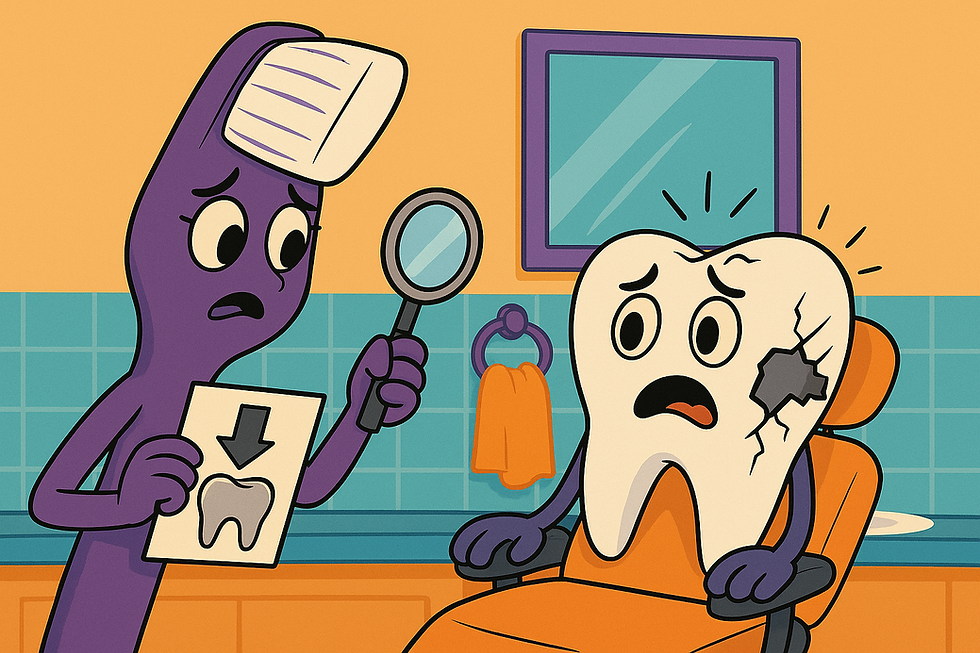
At the core of every tooth lies the pulp—a soft tissue filled with nerves and blood vessels that keeps the tooth alive. When decay gets deep, or a tooth is injured, that pulp can get dangerously close to exposure… or actually become exposed.
Root canal treatment is one way to deal with a damaged or infected pulp—but it’s not always necessary if the pulp is still healthy or just mildly inflamed. That’s where pulp capping comes in.
What Is Pulp Capping?
Pulp capping is a technique where we place a special medicated material over the pulp or near it, encouraging it to heal and protect itself by laying down new hard tissue (called tertiary dentin). There are two types:
Indirect Pulp Capping
In this case, decay has gotten very close to the pulp—but hasn’t reached it. Instead of aggressively removing all the deep decay, we gently stop short, leaving a thin layer of softened, but not infected, affected dentin near the pulp to avoid triggering a pulp exposure.
We then seal the area with a biocompatible material that supports healing and encourages the pulp to deposit new dentin over time. Later, a permanent restoration (like a filling or crown) goes on top.
This is a conservative approach, and in the right situations, it works beautifully to save the tooth’s vitality.
Direct Pulp Capping
Here, the pulp is actually exposed—either from trauma or during decay removal. Instead of going straight to a root canal, we place a healing material directly on the exposed pulp. This is more delicate and only appropriate when the pulp is still healthy or only mildly inflamed.
Again, the goal is to give the pulp a chance to repair itself, avoiding the need to remove it entirely.
What Materials Do We Use in Pulp Capping?
We don’t just use any filling material. These are specially formulated biocompatible substances that can stimulate the pulp to heal and lay down new dentin. Most of them release calcium ions, which help trigger mineralization.
Here are some common materials:
MTA (Mineral Trioxide Aggregate)
A gold standard in pulp therapy. MTA has excellent sealing ability, is highly biocompatible, and releases calcium ions that help form a dentin bridge. The downside? It can be hard to handle and takes a while to set.
Biodentine
A modern alternative to MTA with similar healing properties. It sets faster, is easier to manipulate, and is known for its excellent bioactivity. Great for both direct and indirect pulp caps.
TheraCal LC
A light-cured, resin-modified calcium silicate material. It’s easier to use in day-to-day practice and still promotes calcium release. Some dentists prefer it for its convenience in shallow pulp caps.
Calcimol LC
A light-cured calcium hydroxide-based liner. While not as bioactive as MTA or Biodentine, it still provides calcium ion release and a protective base under restorations.
All of these materials aim to soothe the pulp, reduce inflammation, and give it the best possible chance to heal on its own.
Can This Really Help Me Avoid a Root Canal?
Sometimes, yes!
When done under the right conditions—healthy or reversibly inflamed pulp, good seal from bacteria, and proper technique—pulp capping can preserve the vitality of your tooth for many years.
But it’s not a guaranteed fix. If the pulp is already irreversibly inflamed or infected, or if symptoms don’t resolve after treatment, a root canal may still be needed.
The Tooth Truth?
Pulp capping is one of the best examples of minimally invasive, biologically driven dentistry. Instead of rushing to remove the pulp, we support your body’s own healing process. When it works, you keep your natural pulp, your tooth stays alive—and everyone wins.


Comments