Tiny Titans of the Tooth: The Nanorobotic Revolution in Endodontics

Welcome to the future of dentistry, where the "scary" root canal is being reimagined as a high-tech playground for microscopic robots. While traditional root canal therapy (RCT) remains the gold standard for saving infected teeth, it faces a microscopic problem: over 10% of treatments fail worldwide. The reason is a labyrinthine dental anatomy that current tools simply can’t navigate. But don’t worry—a swarm of nanobots is on the way to save your smile.

The Hidden Battlefield: Why Standard Tools Fail
To understand why we need robots, we have to look at the battlefield. Your tooth isn't a solid block; it’s a porous fortress. Dentine is filled with hollow, tapering tubules that traverse from the inner root canal to the outer cementum. These tubules narrow from a diameter of ~2.5μm at the opening to a tiny ~0.9μm deep inside.
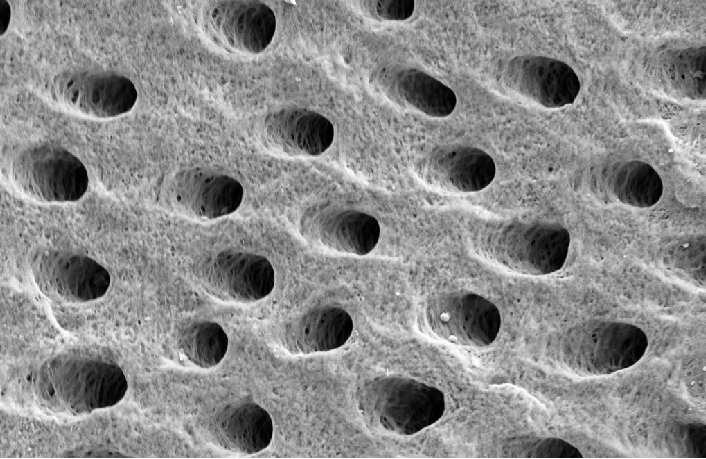
Fun Fact: There can be up to 32,000 tubules per square millimeter of your root surface (Abozaid et al. 2025).

Inside these microscopic tunnels, bacteria like Enterococcus faecalis hunker down, naturally protected from your body’s immune system because there is no local blood supply. Current techniques rely on "passive diffusion"—essentially soaking the tooth in sodium hypochlorite—which often fails to reach the depths where these bacteria reside.
Research suggests bacteria can penetrate tubules up to 1,500 μm, while traditional irrigation methods struggle to go beyond a few hundred (Bathla et al. 2024).
Meet the Bots: From Helices to Swarms
Researchers have developed several types of "active matter" to hunt down these deep-seated invaders:
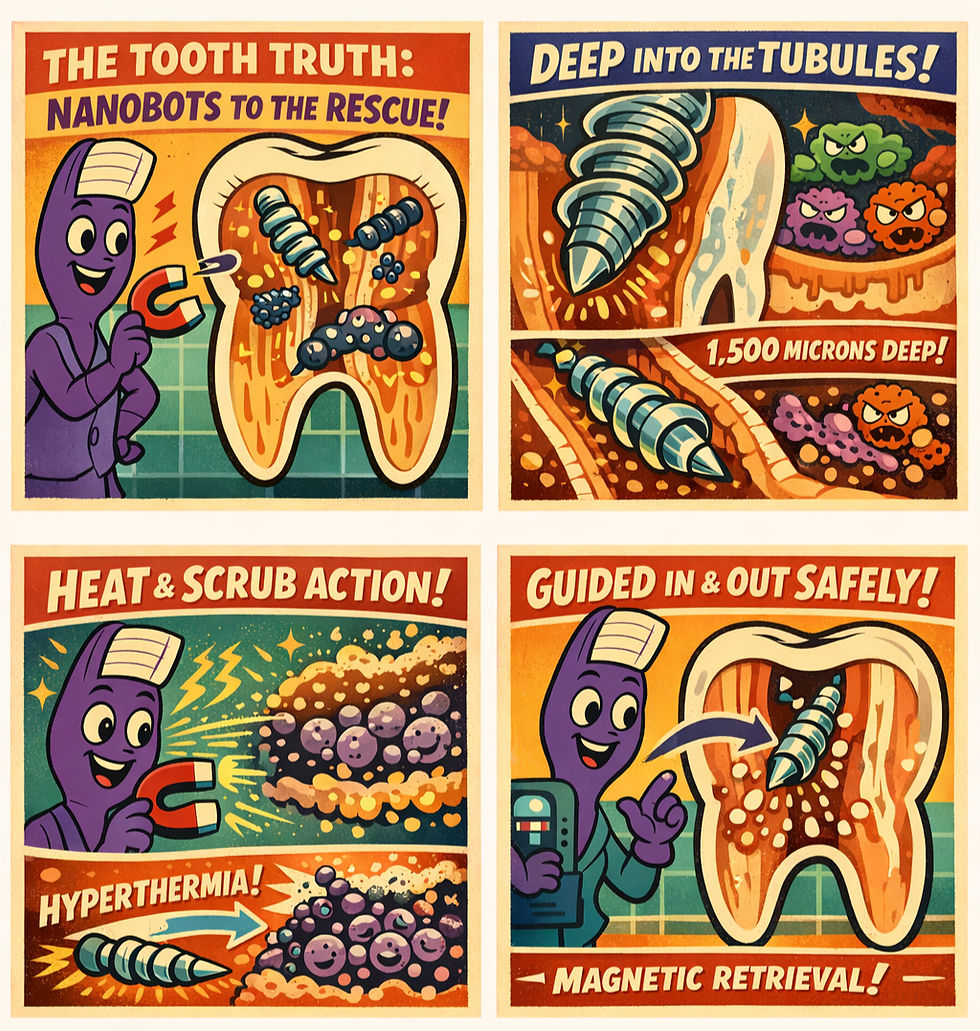
Helical Nanopellers: Developed by the Indian Institute of Science (IISc) and Theranautilus, these are corkscrew-shaped bots made of silicon dioxide with a magnetic iron coating. Inspired by bacterial flagella, they use a rotating magnetic field to "screw" themselves through fluid and into tubules.

Aggregated Microswarms: As described by Babeer et al. (2022), these are dynamic "collectives" of iron oxide nanoparticles (IONPs) that act like a liquid robot. They can reconfigure and adapt their shape to fit into narrow isthmuses or complex canal ramifications.

Nanochains: Scientists recently demonstrated that magnetic nanochains, inspired by planktonic bacilli, can disrupt biofilms with unprecedented efficiency (Kolosnjaj-Tabi et al. 2025). These consist of multiple superparamagnetic maghemite particles that self-assemble into "micro-mats" or "micro-bundles" under magnetic fields.

3D-Molded Soft Helicoids: These are miniaturized robots (~700μm by 1.5 mm) made of biocompatible hydrogels embedded with magnetic nanoparticles.

Multi-metallic Nanorods: A team led by HKBU has unveiled bots equipped with silver and gold nanorods that achieve 99.99% antibacterial efficacy while being navigated by magnetic fields (Leung Cham-fai et al. 2025).

The Superpowers: Speed, Heat, and Retrieval
Why use a robot instead of just more chemicals? Because nanobots are faster and more versatile.
100x Faster: Magnetically driven nanobots can reach the depths of dentinal tubules up to a hundred times fasterthan current clinical practices (Dasgupta et al. 2021).
Deep Penetration: While laser pulses (PIPS/SWEEPS) can push irrigants up to 900 μm, helical nanobots have demonstrated successful penetration about 2,000 μm (2 mm) deep into the tubules (Bathla et al. 2024).
Hyperthermia (Localized Cooking): By adjusting the frequency of the magnetic field, researchers can make the nanobots' surface vibrate and generate localized heat. This "hyperthermia-based bactericidal method" can destroy the resilient E. faecalis in just 15 minutes without damaging surrounding healthy tissue.
Mechanochemical Synergy: Swarms don't just kill; they "scrub". They generate shear forces that physically loosen the "slime layer" (extracellular polymeric substance) that protects bacteria.
Fun Fact: A single 0.5 ml drop of water can hold one billion nanobots (Bathla et al. 2024).
The "Digital Twin" and AI Integration
The future of endodontics isn't just about the bots; it’s about the brain behind them. Researchers are moving toward "Bio-Futuristic Endodontics" where Artificial Intelligence (AI) and 3D imaging work in harmony (Abozaid et al. 2025).

Using Cone Beam Computed Tomography (CBCT), dentists can create a "digital twin" of a patient's tooth to simulate nanobot trajectories before the procedure begins. AI models, specifically convolutional neural networks (CNNs), already identify root canal configurations with over 90% accuracy, helping robots navigate complex C-shaped canals or calcified blockages.
Retrieval: The Ultimate "Save" Button
One of the biggest concerns with nanoparticles is leaving them in the body. Fortunately, magnetic nanobots have a built-in exit plan. By switching the magnetic field from an oscillating to a rotating drive, dentists can maneuver the bots back out of the tooth once their mission is complete. This retrieval capability ensures high clinical safety and prevents any potential toxicity from long-term accumulation.

From Hunters to Healers: The Regenerative Future
Nanobots are evolving from "hunters" (killing infection) to "healers" (restoring vitality).
Targeted Delivery: Nanobots can act as "micro-submarines," carrying cargo like growth factors or stem cells to the tooth's apical region to promote pulp-dentine regeneration.
Stimuli-Responsive Scaffolds: Smart hydrogels can release medication only when they detect a specific pH or enzymatic cue from an infection, ensuring treatment is only active when needed (Abozaid et al. 2025).
The Roadmap to 2026

This isn't science fiction anymore. Theranautilus, an IISc-incubated startup, is already developing a medical device that fits inside the mouth to allow dentists to inject and manipulate these bots during routine RCT. Human clinical trials are projected to begin in 2025, with a commercial launch potentially as early as 2026 (Alrehaili et al. 2025).

Fun Fact: The first "dental microscope" was born in 1981 and was called the "dentiscope". We've come a long way from the simple glass lens!
Conclusion
Nanorobots represent a paradigm shift in oral healthcare, turning the tide against antibiotic-resistant biofilms and anatomical complexity (Veseli 2024). As we merge AI, 3D printing, and nanotechnology, the root canal will transform from a dreaded procedure into a masterclass in precision medicine.


Analogy for Understanding: Imagine trying to clean a deep, winding cave (the root canal) with a garden hose (standard irrigation). The water might reach the entrance, but it won't get around the sharp corners or into the narrow side-tunnels. Now, imagine sending in a swarm of well-trained, heat-emitting robotic ants (nanobots) that can crawl into every crack, scrub the walls, and then march back out when the job is done. That is the power of nanodentistry.


Comments